
Family Ministry

The Raíces y Alas Program Committee chose to integrate the focus on Hispanic Family Ministry with two other key ministerial priorities: evangelization and vocations. What follows is first a summary of the current reality of Hispanic families. We then present an overview of the family’s role in evangelizing its members and in building community. Finally, we briefly reflect on the family’s role in fostering vocational discernment in the lives of children and young people.
The Reality of Hispanic Families in the Church
Strengths
Hispanic families are deeply rooted in their sense of family, extended family, community, and hospitality—providing fertile ground to live as domestic churches.
The vast majority of Hispanic families are believers whose family faith life is nourished by multiple expressions of popular devotions and religiosity.
Parents and grandparents feel called to ensure that children and youth receive the sacraments and are formed in the faith.
Challenges
Many Hispanic Catholics grow up in culturally Catholic homes and communities, yet without a deep understanding of the faith. For many, Catholicism is lived more as tradition than as conviction.
Language and cultural barriers, along with demanding work schedules, often weaken intergenerational relationships. Instead of building connections across generations, this dynamic fosters isolation and limited daily interaction within families.
Mental health concerns—such as depression, anxiety, grief, and loneliness—have increased, especially since the pandemic, which has disproportionately affected Hispanic families.
Addictions to alcohol, drugs, pornography, digital media, and the rise of domestic violence profoundly harm family dynamics.
Many couples live in irregular or non-sacramental marriages. These couples need pastoral accompaniment toward convalidation, so that they may better understand the Church’s teaching on marriage and grow in their sacramental life.
There is a lack of adequate care for the elderly and of intentional intergenerational accompaniment throughout all stages of life.
A significant percentage of Hispanic families are undocumented or live with undocumented relatives. Fear of deportation, family separation, and financial hardship causes deep distress and often contributes to domestic violence, abuse, addiction, divorce, and separation.
Gender ideologies, amplified by social media, are causing confusion among Hispanic children and youth, straining parent-child and other family relationships.
The pandemic disrupted family life, leading to the loss of loved ones and weakening the regular practice of attending Mass. Families remain concerned about the safety measures the Church will provide to encourage their return.
The Reality of Evangelization in Hispanic Families
Key challenges include:
Catechetical models often fail to form missionary disciples and do not adequately respond to the needs of Hispanic families.
Parents are often unprepared to live as disciples in the Church and community, and many struggle to share their personal testimony of faith with their children.
Families are rarely invited personally or mentored to participate in parish programs and activities.
Religious education and sacramental preparation programs frequently lack a truly transformative dimension that invites families to a personal and communal encounter with Christ.
Many parishes lack welcoming communities and do not have enough trained or committed volunteers to encourage and accompany families.
The Reality of Vocations in Hispanic Families
Family life and vocational ministry are interconnected in fostering the universal call to holiness in Hispanic families and encouraging vocational commitments among Hispanic youth and young adults—whether in marriage, priesthood, or religious life.
Strengths
Growing awareness of the need for Pastoral de Conjunto to promote vocations.
Increasing diocesan commitment to support vocations from the Hispanic community.
A growing number of formation programs that connect Hispanic youth and young adults with leadership and vocational pathways.
Greater support in seminaries where language and culture are affirmed and valued.
Challenges
Many parents lack a clear understanding of vocations and therefore struggle to encourage and support their children’s vocational discernment.
There is a growing need for effective catechesis and youth ministry for second- and third-generation Hispanics that integrates family life and vocation.
Families often lack formation on the sacrament of marriage and the broader meaning of vocation.
Hispanic youth, especially of the second generation, need to be invited into moments of encounter and vocational discernment.
Greater cultural, racial, and linguistic awareness is needed in vocation promotion and recruitment efforts.
Conclusion
In summary, Hispanic families bring many gifts but also face significant challenges. Amidst today’s complexities, our mission as pastoral leaders is to be a prophetic voice of hope, strengthening and accompanying families so that they may fully live out their vocation as “a community of life and love.”
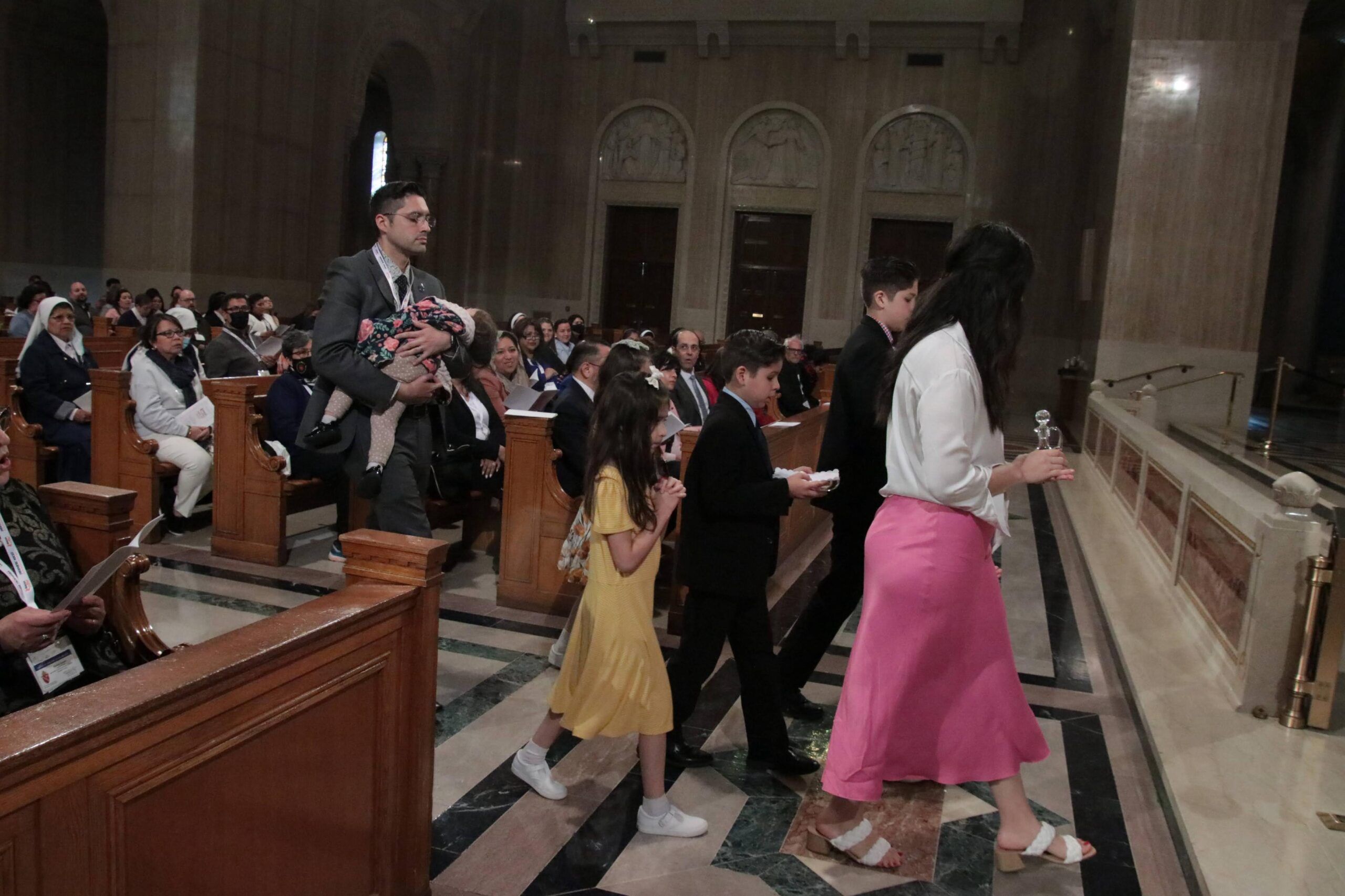
Family Ministry Team
Serving Families at the Heart of the Church’s Mission
Team Lead
Jake Samour
Director, Office of Marriage and Family Life, Diocese of Wichita
Hispanic representative for NACFLM (National Association of Catholic Family Life Ministries); member of NACFLM Region IX
Chairperson for the new Federation of Hispanic Family Ministry
Subgroup: Family
Ricardo and Lucia Luzondo – Directors of Intercultural Ministries, co-founders and Directors of Hispanic Outreach at Marriage Building USA / Construyendo Matrimonios USA, Inc., and co-founders of Family Renewal Ministries, Inc. (Renovación Familiar)
Julia Dezelski – USCCB Assistant Director, Marriage & Family Life
Carla Ferrando-Bowling – Director, Family Life Office, Archdiocese of Washington
Eva Gonzalez – Director of Hispanic Ministry, Archdiocese of Louisville; NCADDHM Region V
Aurelio and Radel Guinto – Couples for Christ
Mike Koley – Foccus, Inc.
Socorro Truchan – Associate Director, Secretariat for Parish Life and Lay Leadership – Domestic Church
Subgroup: Vocations
Fr. Rafael Capó – Vice President for Mission, St. Thomas University
Fr. Luke Ballman – USCCB Executive Director of Secretariat for Clergy, Consecrated Life, and Vocations
Veronica Lopez Salgado – Communications, Translations and Speaker, Diocese of Jackson, MS
Mario and Paola Martinez – Marriage and Family Life Ministry, Diocese of San Bernardino
Dania Sanchez – Coordinator, Pastoral Juvenil Hispana, Region X – Dallas, TX
Rosalba and Sergio Cardona – National Board Members, Movimiento Familiar Cristiano USA (MFCC-USA)
Subgroup: Evangelization
Kathia Arango – Office of Hispanic Catholics, Archdiocese of Philadelphia
Andres Arango – Bishop’s Delegate for Hispanic Ministry and Director of Evangelization, Diocese of Camden, NJ
Dulce M. Jimenez – Translator/Editor, Religious Education Consultant
Tony and Sue Morris – U.S. Ecclesial Team, Worldwide Marriage Encounter
Fr. Tom Ogg – U.S. Ecclesial Team, Worldwide Marriage Encounter